Sunday, 28 April 2013

Purchasing Popularity: Fake Followers & Accounts Still Plague Social Networks

When implied popularity can be purchased, a problem will arise. That’s exactly what has been plaguing social media, a blatant spamming to help promote accounts, updates or links. Social spam is so popular that it has even become a multi-million dollar business. Politicians, celebrities, sports figures and Internet marketing “gurus” have been purchasing handfuls of followers in order to  instantly add implied popularity. Purchasing followers and retweets is cheap, and it can make you look good … for now.

Yesterday, the The New York Times featured two researchers that called out celebrities and brands that include Pepsi, Mercedes-Benz, Newt Gingrich, Jared Polis, 50 Cent and more. The research looked at large gains in Twitter followers in one day that were deemed unnatural. The issue has also spread to retweets and shares in order to get messages seen by more folks.

So what’s it in for the user… why buy the fake followers? Firstly, while the followers are fake  it isn’t easy for the average user to see; many get away with it. More importantly, it’s embarrassing to not have an audience. Imaging alleged Twitter-buying Mitt Romney competing against President Obama for the presidency with one-50th of the following. Or for a celeb who joined Twitter late in the game to only have a few thousand followers. It is very easy to look inadequate on Twitter. Followers can also show an indicator of power. Here’s an example of how alleged Twitter follower-buying handicapper Danny Sheridan used Twitter numbers to help strengthen his message in an email. He throws out his follower count in the first sentence to add importance to himself and his message. Simply put, Twitter followers equate to implied popularity/power.

Want to see through the spam? There are some tools that exist to try and monitor fake followers like SocialBakers’ Fake Followers or StausPeople. While these tools attempt to show the volume of fake vs. real accounts they should be taken with a grain of salt. The numbers aren’t precise but can be used to look toward the bigger picture – the percentages. It looks like 21% of my follower count is chalked up to spam/empty followers:
Greg-Finn
While other accounts of alleged Twitter purchasing feature vastly different percentages (in the wrong direction):
dannysheridan
What can we do about it? Unfortunately, not much. Twitter has been getting much better at identifying and deleting fake accounts, but the low cost to purchase makes it easy for users to keep spamming. Last year at SMX Social Twitter Head of Trust & Safety Del Harvey mentioned that the fake followers were low on their priority as they’ve been targeting more egregious hacking.

The best course of action with all this is to pay attention to quality, not follower number and wait for the social networks to straighten it all out.

http://marketingland.com/purchasing-popularity-fake-followers-accounts-still-plague-social-networks-41537

Wednesday, 24 April 2013

One of the Easiest Paths to JV Success and Making Money Online

Hi, this is an article from Brian Koz's website. Brian is a brilliant guy. It was posted in 2008. But I think the idea is still valuable to today's day.

One of the Easiest Paths to JV Success and Making Money Online


Many of you probably know that perhaps the hardest part about making money online isn't coming up with a good product, sales copy, or website graphics ... it's getting JV partners, forming business relationships, and all about getting the people who can help you make more money to actually help you.

Well, I'm about to share with you one of the biggest tips I have that have led to a lot of my own online successes.

Too many people go about forming business partnerships the wrong way (whether you're looking for more JV partners to promote your own stuff or finding the right partners who can help bring your idea to life). They'll only focus on what OTHERS can do for them. The key is to also focus on what YOU can do for OTHERS.

I'll say that once more. Before you go trying to see what others can do for you, try to see what you can do for them.

It doesn't matter if you don't have a huge list, no marketing experience, etc.. If you can offer something that makes their lives easier, brings them the potential for more money, or helps them in any other way, you'll stand out and will be much more likely to be considered.

If you just go up to them, ask them to promote your product or partner with you without laying out how you can REALLY help them, you'll probably never be able to land a good partnership.

And let's be realistic with ourselves here too -- you don't want to offer them something that you realistically can't do. I've seen complete newcomers talk about how if a big name JV's with them, the big name will benefit by making soooooooo much money from them.

Let's get real. They can make money off of any product they promote. How are you different?

Or I'll see people wanting to partner up on a project, but the only thing they'll bring to the table is an idea. Let's get real again. Am I or anyone else going to want to waste time, money, etc. on something and share the profit with you if all you do is come up with an idea?

Give them a product instead of just an idea, offer to do the manual labor, etc. and you'll surely get MUCH more attention and be much more likely to land a successful business partnership.

So change your thinking to reflect this and start making some serious dough.

http://www.briankoz.com/2008/02/one-of-easiest-paths-to-jv-success-and.html

Saturday, 13 April 2013

Survey: 90% Of Customers Say Buying Decisions Are Influenced By Online Reviews

According to a new survey conducted by Dimensional Research, an overwhelming 90 percent of respondents who recalled reading online reviews claimed that positive online reviews influenced buying decisions, while 86 percent said buying decisions were influenced by negative online reviews.
 
Zendesk - has reading online reviews impacted your buying decision
 
The survey, sponsored by Zendesk in the early part of 2013, included responses from 1,046 participants. Respondents had to be in the United States, and had to have experienced a recent customer service issue with a midsized company, either as a consumer or in a business context.
Approximately two-thirds of the 1,046 respondents reported reading online reviews. While Facebook was the leading resource for positive reviews, the most common place to find negative reviews were online review sites.
 
Zendesk - do you recall reading a review

When asked what made a customer service interaction bad, 72 percent of the respondents blamed having to explain a problem to multiple people, while only 51 percent blamed a bad customer service interaction on the problem not being resolved.

Zendesk Survey - what made CS bad

Not only are customers most frustrated with the way customer service issues are handled, 58 percent said they were more likely to share customer service experiences today than they were five years ago, with more and more people sharing experiences on social networking sites and writing online reviews.

Of the respondents who shared negative experiences, 45 percent used social media and 35 percent shared via online review sites.

When respondents were segmented, 100 percent of the participants who earned $150K or more a year, said they shared bad customer service interactions with others.

Zendesk Survey - shared customer service interactions with others

B2B companies were more likely to benefit from customers who had a good customer service interaction with 62 percent of respondents saying they purchased more products or services from a B2B company following a positive customer service experience. Only 42 percent of positive B2C customer service interactions resulted in customers buying more products or services.
Key findings of the study illustrated that customer service not only affects revenue, but has a long lasting impact, with customer service ranking as the No. 1 factor influencing how much a consumer trusts a company.

Zendesk Survey - factors that impact trust

The overall takeaway from the survey is that midsized companies create better customer experiences when they react quickly to a customer service issue.

Because a company’s social media channels and website are managed most often by marketing, the study offers strong evidence toward the importance of customer service working hand-in-hand with marketing to respond quickly to online reviews and addressing customer concerns that are delivered via a company’s site and social media channels like Facebook and Twitter.

http://marketingland.com/survey-customers-more-frustrated-by-how-long-it-takes-to-resolve-a-customer-service-issue-than-the-resolution-38756

Wednesday, 10 April 2013

Small Business Blog, Big Business Results

Businesses of all sizes often struggle to find high impact, low cost methods of attracting and engaging customers.

While some say social media and SEO have leveled the playing field, blogging is by far one of the most effective ways for small businesses to achieve numerous business objectives.

What can you achieve with a blog? As a content management system that can be optimized for search and social shares, blogs with great content can help a company attract new customers, engage existing customers, connect with journalists and connect with potential new hires. There are many business communication goals that can be realized through blogging.

How? The fundamentals that many companies seem to gloss over include:
  • Create a hub and spoke framework for blog publishing and promotion.
  • Source content that customers care about and that can influence sales or other goals.
  • Integrate blogging with SEO, Social Media, PR and Content Marketing efforts to amplify content where customers are actively looking.
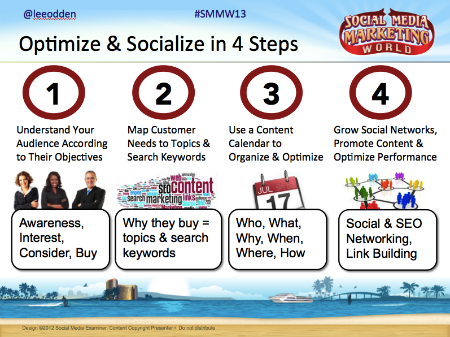
Those are general guidelines, so here are 4 steps for small business blogs to get big business results:

Small Business Blog, Big Business Results

Optimize & Socialize Framework for Blog Content – Slide from #SMMW13 Presentation
 
1. Understand your  audience according  to their objectives – Don’t simply lead content planning with “we need to increase sales of product 123.” Think about your buyer and what goals your product solves for them. Ask how and why, too. The answers will reveal a more meaningful story that you can use when planning blog content.

2. Map customer needs to topics &  search keywords – If your target audience are potential buyers of your products, then describe how those needs are met. Further distill those descriptions to keyword lists, which can be researched and filtered using Google AdWords Keyword Tool.

3.  Use a content calendar to organize & optimize – Failure to plan is a plan to fail, so be sure to create a content planning calendar to identify when you will create what kind of content on what kind of topics. Here’s a free blog content template for this.

4. Grow social networks, promote content & optimize performance – A hub and spoke publishing model only works if there are people watching, monitoring and subscribed to your content. Make an effort to share useful content from others and engage wherever possible. Being useful is a great way to build your social networks. When you do promote your own content to social networks, make sure it delivers on the promise.

If you empathize with the audience you’re after and plan relevant blog content in a way that makes it easy for people to find in search and share on social, then you’ve optimized your way from a small business blog to big business results.

If you’re a small business blogger, what are some of the obstacles you’re facing? Maybe you’ve overcome those challenges – what lessons have you learned for getting better performance from your blogging effort?

http://www.toprankblog.com/2013/04/small-business-blog-big-business-results/